

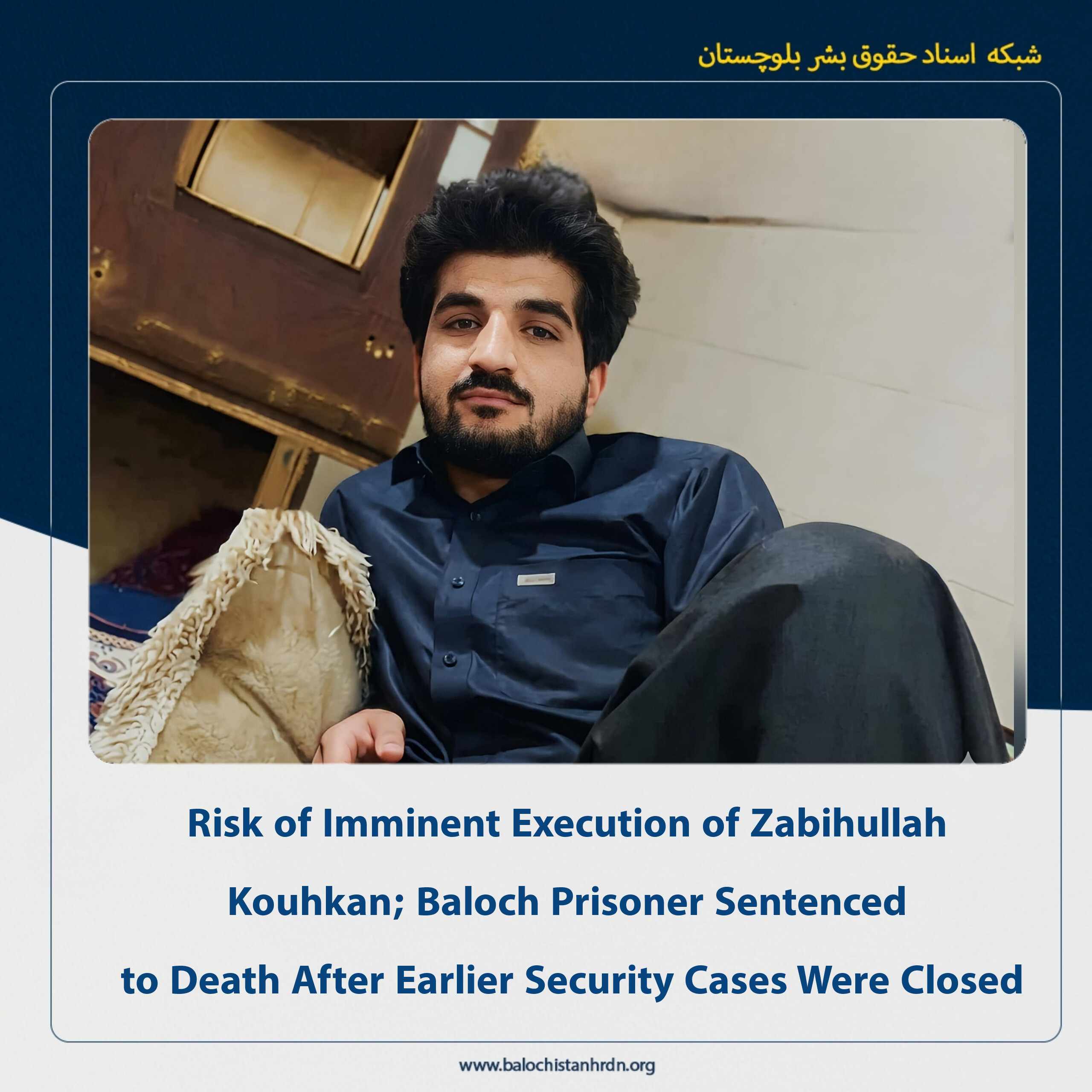
Zabihullah Kouhkan, a Baloch prisoner held in Zahedan Central Prison, is facing the risk of imminent execution. Judicial documents indicate that over the past several years he had been arrested and prosecuted in multiple security-related and criminal cases involving serious allegations, including moharebeh (“enmity against God”), acting against national security, possession of military-grade weapons, and murder. However, those cases did not result in a death sentence due to the failure of security authorities to substantiate the allegations. He is now facing execution in a separate case involving private complainants, while his family and informed sources continue to raise serious concerns regarding the fairness of the judicial proceedings.
According to the Balochistan Human Rights Documentation Network (BHRDN), Zabihullah Kouhkan, a Baloch citizen sentenced to death, is currently being held in Ward 8 of Zahedan Central Prison. Prison authorities have reportedly contacted the private complainants regarding preparations for the implementation of his death sentence, raising concerns that the execution may be carried out in the near future.
Zabihullah Kouhkan, 34, son of Majid, is married and the father of two children. He is a resident of Badr 25 Street in Zahedan.
A review of judicial records shows that Kouhkan had previously faced several security-related and criminal cases involving allegations such as moharebeh, acting against national security, possession of military-grade weapons, and intentional murder. However, these cases did not lead to convictions after security agencies failed to establish the charges. In several murder cases, the families of the deceased reportedly withdrew their complaints after reviewing the circumstances of the cases.
The case that ultimately resulted in Kouhkan’s death sentence relates to the killing of Mansour Shahnavazi (Nehtani) on November 2, 2022. According to court records, Shahnavazi and Mansour Barahoui (Azbegzehi) were travelling toward Zahedan in a Toyota vehicle on the Garagheh–Tal-e Siah road when they came under fire from armed individuals travelling in a silver Peugeot 405. Shahnavazi was killed in the attack, while Barahoui sustained injuries.
According to available documents, during the initial stages of the investigation the victim’s family stated that they had no information regarding the identity of the attackers and that Shahnavazi was not known to have any significant disputes with any individual. Nevertheless, subsequent investigations were directed toward implicating several members of the Kouhkan family, including Zabihullah, Idris, Benjamin, Bilal, and Iman Kouhkan. Sources indicate that the investigation was led by security agencies and a police investigator identified by the surname “Del Arami,” who was responsible for the case.
Sources speaking to BHRDN stated that after security and judicial authorities failed to substantiate the earlier security-related allegations against Zabihullah Kouhkan, they encouraged the family of Mansour Shahnavazi, who had been killed by unidentified armed assailants, to seek blood money (diya) from the Kouhkan family and to identify Zabihullah as the alleged perpetrator. Mansour Barahoui, who survived the attack, reportedly attended mediation sessions held at the Makki Mosque in Zahedan in the presence of local elders, during which he repeatedly maintained that Zabihullah was innocent.
According to the verdict issued by Branch One of the Juvenile Division of the Criminal Court One of Sistan and Baluchestan Province, the primary evidence relied upon by the court to attribute the killing to Zabihullah Kouhkan consisted of statements and confessions allegedly made by him and several co-defendants during police interrogations.
According to informed sources, these confessions were obtained under physical and psychological torture. Kouhkan repeatedly rejected the murder allegations throughout the proceedings and maintained his innocence.
The judges who issued the verdict were Seyed Moein Javadi, Jalal Bagnazar, and Mohsen Golmohammadi Tolaei. The defense team included Abutaleb Ayaz as the privately retained lawyer for Zabihullah and Idris Kouhkan, Moradali Khaleghpanah Araghi as court-appointed counsel for Bilal Kouhkan, Farzaneh Momeni as court-appointed counsel for Iman Kouhkan, and Ahmad Alijani as court-appointed counsel for Benjamin Kouhkan.
The initial confessions, later retracted by the defendants, alleged that several of the accused were present at the scene in a silver Peugeot 405 and that Zabihullah Kouhkan fired at the victim’s vehicle. During subsequent proceedings, however, Kouhkan and the other defendants denied any involvement in the killing and stated that they were not present at the scene when the incident occurred.
Sources familiar with the case state that much of the prosecution’s case rests on confessions that were later repudiated by the defendants. According to these sources, no independent forensic or conclusive technical evidence has been presented to establish Zabihullah Kouhkan’s presence at the scene of the shooting.
Another disputed aspect of the case concerns the testimony of Mansour Barahoui, the sole surviving witness to the attack. According to relatives of the defendants, the manner in which his statements were interpreted and relied upon during the proceedings remains highly contentious.
The court verdict also notes that Benjamin Kouhkan was under the age of eighteen at the time of the incident and was accused of aiding and abetting the murder. Idris Kouhkan was convicted of complicity in the killing through allegedly driving the vehicle used by the shooter. Other defendants in the case received lengthy prison sentences and detention orders in juvenile correctional facilities.
Relatives of Zabihullah Kouhkan and sources familiar with the case have pointed to what they describe as serious irregularities in the investigation, the extraction of confessions, and the evidence relied upon by the court. They have called for a halt to the execution, a renewed examination of the case, and a review of the judicial proceedings.
Sources further emphasized that several previous cases had also been attributed to Zabihullah Kouhkan and some of his relatives, yet the families of the alleged victims ultimately withdrew their complaints after reviewing the circumstances of those cases.
Kouhkan is currently being held in Ward 8 of Zahedan Central Prison following complaints filed by two private complainants, identified as Ms. H. Narouei and Ms. M. Bamari. Given the imminent risk of execution, concerns are growing that an irreversible punishment may be carried out in a case that remains disputed and controversial.
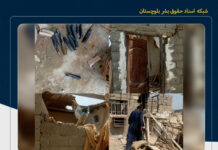
It should be noted that on September 19, 2023, security forces reportedly raided Kouhkan’s home without presenting a judicial warrant. According to sources, officers entered the property by climbing over the courtyard wall, breaking windows and metal barriers, and creating fear and distress among his wife and children before arresting him. During his detention, he was allegedly subjected to physical and psychological torture aimed at extracting forced confessions.